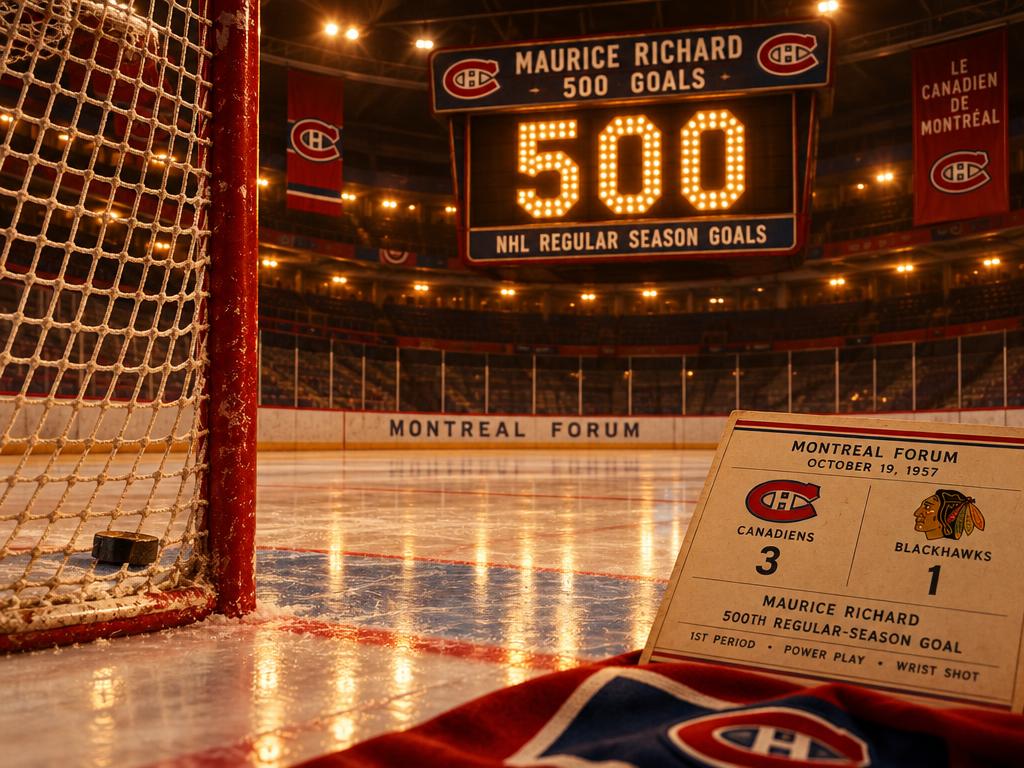
On October 19, 1957, the NHL acquired a milestone it had never recorded before. Maurice Richard scored his 500th regular-season goal during Montreal's 3–1 victory over Chicago at the Forum. The number marked a new boundary for sustained scoring in the league, reached during an otherwise ordinary early-season game.
The goal came on a first-period power play. Jean Béliveau delivered the puck, and Richard beat Chicago goaltender Glenn Hall with a wrist shot. The scoring record credits Béliveau and Dickie Moore with assists. At 15:52 of the period, a single finish changed the meaning of the evening.
The distinction matters because the total concerns regular-season goals. Playoff scoring has its own record and is not added to the count. Richard reached 500 within the same category later generations would use to measure the league's most productive finishers. It was a new benchmark, not a rounded collection of every competitive goal.
Montreal still had a game to complete, and the Canadiens won 3–1. The power-play goal belonged both to that night's result and to a much longer accumulation of scoring. That combination gives the event its appeal: a familiar hockey sequence, pass and shot, became the first example of an achievement that future stars would chase.
The October 19 goal established a threshold other players would measure themselves against. It offers a precise moment when an individual scoring total became part of hockey's shared vocabulary. Each later player joining the club could be counted against a standard that began here, on the Forum ice, with a first-period goal against Chicago.