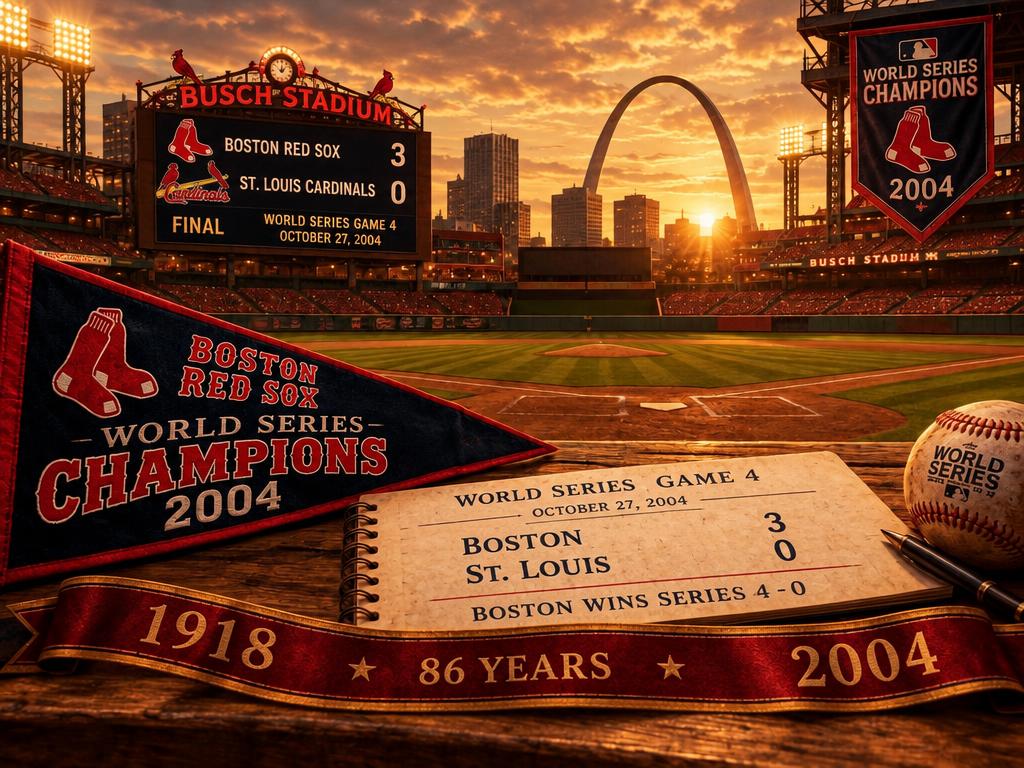
On October 27, 2004, the Boston Red Sox finished a championship pursuit that had stretched across 86 years. A 3–0 victory over the St. Louis Cardinals at Busch Stadium completed a four-game World Series sweep. Boston had won its first title since 1918, closing a gap that had shaped the franchise's identity.
Johnny Damon gave the final game an immediate direction with a leadoff home run. In the third inning, Trot Nixon's double brought in two more runs. That was all the scoring Boston needed, but an early three-run lead still required a full night of pitching and defense before it could become a championship.
Derek Lowe handled seven scoreless innings. The bullpen carried the shutout through the eighth, and Keith Foulke took the ninth. The final out came on Edgar Rentería's ground ball back to the mound. Foulke threw to first, turning the long-awaited ending into a straightforward baseball play.
The sweep followed an even more improbable escape. In the American League Championship Series, Boston had recovered from a three-game deficit against New York to win four straight. That comeback supplied the opening; the four wins against St. Louis completed the work. Eight consecutive postseason victories separated elimination danger from the final celebration.
The date is remembered because the result changed a sporting story that had endured for generations. It did not erase earlier losses or make those games less painful in retrospect. It gave them a different endpoint. The 2004 title became a finished achievement rather than another almost, recorded through a leadoff homer, a two-run double, a shutout and the final throw to first.