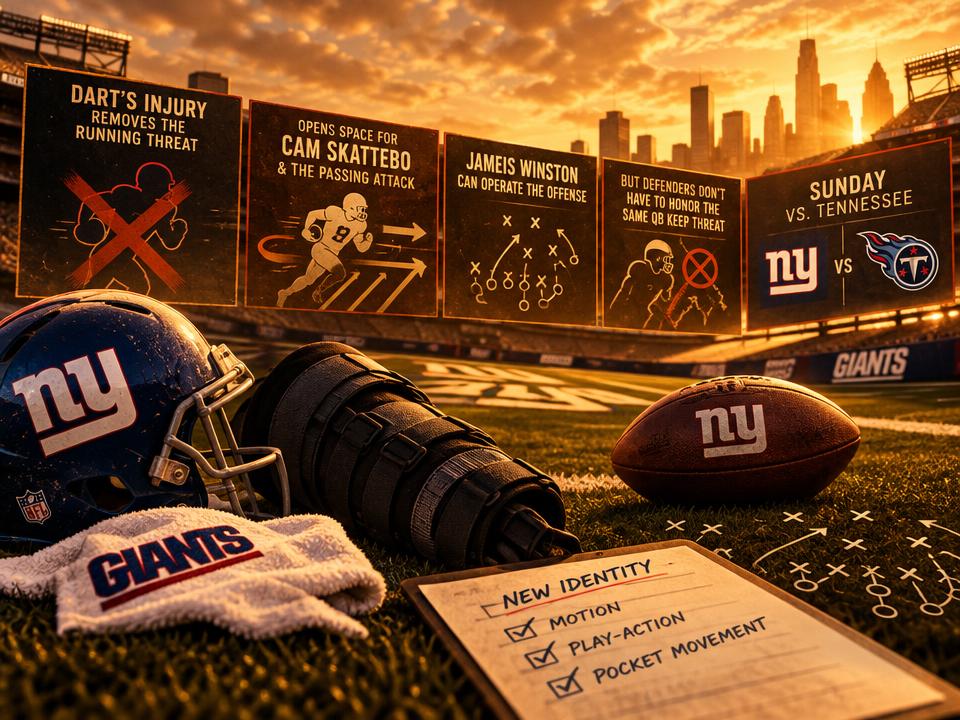
The Giants did not just lose their starting quarterback. They lost the extra player their run game made defenses account for before the snap. That is the deeper cost of Jaxson Dart’s season-ending knee injury: New York has to replace his production, yes, but first it has to replace the hesitation he created. Jameis Winston can run the offense. He cannot make a defense solve the same math.
Look at the Week 1 win over Dallas. Dart completed 23 of 29 passes for 230 yards and three touchdowns, added 54 rushing yards, and New York ran for 170 yards on 34 non-kneel-down attempts. That balance was not just a running back carrying the afternoon. Dart’s legs made the edge defender and backside linebacker pause. Even when he handed off, the threat of keeping the ball changed how quickly defenders could chase the play.
Think of it like a basketball pick-and-roll. A point guard who can turn the corner forces the defense to guard the ballhandler and the roller; that split-second choice creates space for somebody else. Dart supplied that problem on the football field. With him under center, a defender who crashed hard on Cam Skattebo could leave a lane for Dart. Sit wide to contain Dart, and Skattebo could get downhill. It is a simple dilemma, but a useful one.
Winston’s replacement appearance against the Rams offered a small, ugly sample: 11 completions on 27 attempts for 111 yards and an interception. One relief stint cannot tell us what he will look like with a week of preparation, and it would be lazy to pretend it can. But the contrast matters. Defenses no longer need to spend the same attention on the quarterback as a runner. They can trigger downhill faster, squeeze the handoff, and make Winston beat tighter coverage from the pocket.
So Harbaugh’s challenge is not to photocopy Dart’s playbook and hope the pieces fit. It is to keep the run game’s force while creating a different conflict. New York can lean into Skattebo, use motion to reveal how the defense is fitting the run, and pair play-action with routes that give Winston clear reads. Moving the pocket can help, too, but it is not the same as a designed quarterback keep: the defense still knows the ball is supposed to leave Winston’s hands.
The key question against Tennessee is whether the Giants can make the defense hesitate another way. If linebackers keep honoring the run, the play-action windows stay open. If they charge downhill without fear of Dart keeping the ball, New York may find itself in obvious passing situations—and that is a rough way to introduce a backup to a full-time job. The Titans game will not answer every question, but it can show whether the offense has a second identity ready.
There is a longer lesson here, too. A mobile quarterback is often described as a bonus runner, as if his rushing value begins only when he carries the ball. The real value starts earlier, in the choices he forces the defense to make. Dart’s 54 yards were visible on the stat sheet; the hesitation he created was not. Now the Giants have to build that hesitation back into the system. What they discover on Sunday could shape not just this offense, but how they protect Dart’s return to it next year.