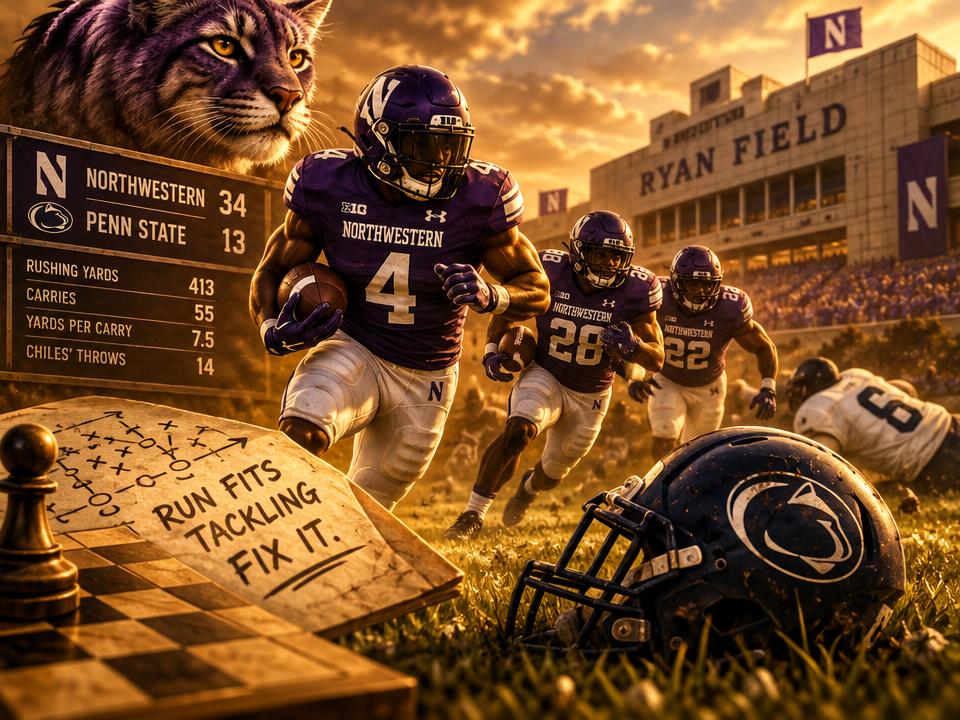
Ryan Field supplied the roar; Northwestern’s run game supplied the reason. In a 34-13 win over Penn State on October 2, the Wildcats turned a sold-out opening night into a trench-level mismatch, rushing for 413 yards while throwing for just 93. That imbalance is the tactical story: Northwestern did not need a high-volume passing attack to control the game. It needed the Nittany Lions to close the run lanes, and they never did.
The contrast was stark before halftime. Northwestern ran for 237 yards in the first half; Penn State managed 26. The Wildcats had opened their season averaging 146 rushing yards per game, then nearly tripled that figure against a defense that had to handle multiple runners and a quarterback capable of keeping the ball. Chiles finished with only 14 pass attempts, but his two-yard keeper for the opening touchdown made him part of the run-fit problem. A defense can’t treat the quarterback as a spectator when he’s an available ball-carrier.
Watch how the scoreline tightened the bind. Northwestern went up 10-0, then Penn State answered to make it 10-7. On the next Wildcat scoring drive, Joseph Himon broke a 36-yard run and followed it with a 38-yard touchdown. Later in the half, Himon added an 11-yard score. Those weren’t long, methodical possessions requiring a pass game to rescue them; they were direct punishment for failing to limit the ground game. Northwestern led 24-7 at the break, with its runners repeatedly flipping field position in a hurry.
The workload split mattered, too. Caleb Komolafe carried 25 times for 188 yards, while Himon gained 162 on 10 attempts. One back could keep the offense on schedule; the other delivered the sharp explosives. Together, they made Penn State defend the whole menu rather than key on a single runner. Northwestern finished with 55 carries at 7.5 yards per attempt, four rushing touchdowns and 19 first downs by run. Chiles completed 10 of 14 passes. That modest passing line wasn’t a weakness to exploit when the ground game kept creating favorable downs.
The new stadium and its 35,000-person crowd clearly made the night feel bigger, but atmosphere alone doesn’t explain 7.5 yards per carry. Northwestern’s defense also helped turn the opening burst into separation: it held Penn State to 48 rushing yards on 22 attempts, forcing the visitors to live through longer passing situations. Penn State threw 41 times, completed 26, and threw two interceptions. The Wildcats’ balance meant they could play from ahead without asking Chiles to win a shootout.
There’s a useful caution before treating this as a permanent blueprint: one game doesn’t establish that Northwestern will rush like this every Saturday, and the new Ryan Field debut was an unusually charged setting. But the film-room question for Penn State is immediate and specific: were explosive runs caused by poor gap fits, missed tackles, or both? Until the answer changes, opponents can make the Nittany Lions prove they can stop the run before asking them to defend the full passing menu. Northwestern made that test the entire game—and passed it emphatically.