The NBA’s new smart-ball trial is less about building a robot referee than giving the humans better evidence. That distinction matters: in select 2026 preseason games, Wilson balls with Bluetooth sensors will collect research data, but officials won’t use it to change calls. The league is testing an assist, not handing the whistle to a gadget. Think less RoboCop taking over the crew, more adding a clean extra angle to the group chat after a chaotic loose-ball sequence.
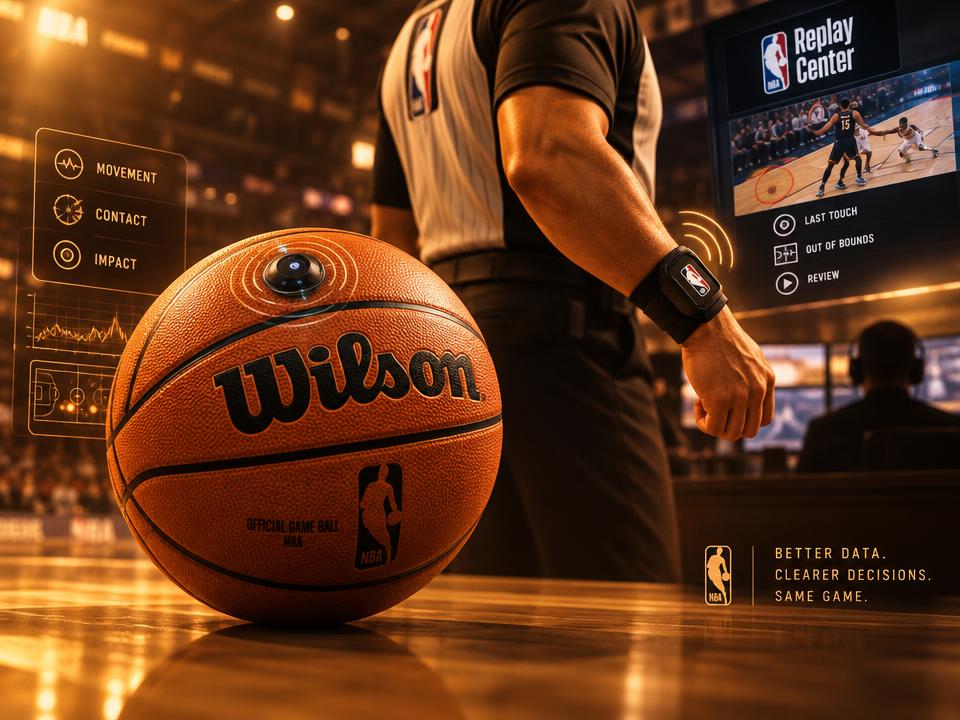
The sensor sits in the ball’s air valve and adds about a gram. It sends measurements such as acceleration to arena antennas, with that information combined with video to build models for possible officiating use. The NBA has already tested connected balls in the G League and Summer League. ESPN reported that the sensor detects contact with the ball, with future uses potentially including last-touch out-of-bounds calls. That’s a narrow, useful lane: tracking a physical event, not deciding whether a defender’s bump was legal.
The officials’ wrist wearables solve a different problem. In designated situations—including replay reviews, scoring changes and clock malfunctions—they let referees communicate with the Replay Center. They do not make the call or replace the review. The value is in connecting the people who already have authority to decide, especially when the crew needs to coordinate quickly. Put the two tests together and the design is clear: one tool gathers evidence from the ball; the other helps move information between officials.
That division is smart because basketball’s hardest calls aren’t all the same kind of problem. “Who touched it last?” is an observable sequence, even when bodies and hands flash through the camera frame. “Was that contact enough to be a foul?” asks officials to interpret the rule and the play. Sensor data may sharpen the first question, but it can’t settle the second by itself. The league’s path is not one giant AI whistle; it’s a set of smaller tools aimed at specific blind spots.
There’s a fan-facing catch, though: better evidence does not automatically mean faster games. If a sensor gives officials a more reliable answer but the process still requires a long stoppage, the possession may be fairer without feeling smoother. And replay certainty carries its own weight: a tiny touch that was invisible at full speed could decide who gets the ball, even if nobody in the building noticed it live. The technology can clarify the moment, but the league still has to choose how much review is worth the interruption.
For now, the boundary is firm. The NBA says the ball data is for research and won’t affect calls in these preseason games; the wrist-wearable technology is not extending into the regular season. Fast Company also reported that the league is checking whether players can detect a difference in the connected ball’s feel or performance—a basic requirement before any wider use. So the real test isn’t whether a sensor can collect data. It’s whether the data stays dependable in live play, fits naturally into officiating, and improves accuracy without stretching every close call into a courtroom scene. If it works, the first win may be a quieter possession decision, not a referee replaced.