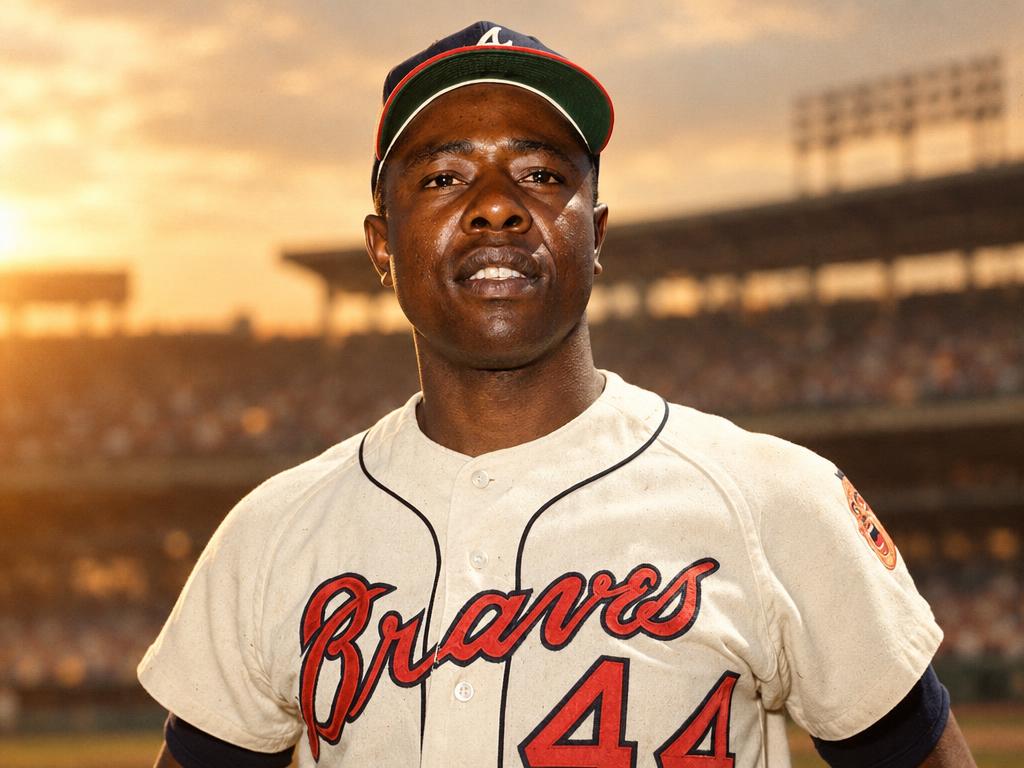
Hank Aaron’s career was built on repetition: a compact swing, a steady presence in the lineup and production that rarely let up. Born Henry Louis Aaron in Mobile, Alabama, he grew up playing baseball on sandlots and sharpened his game in the Negro Leagues before the Boston Braves signed him. He began in the minors, then made his major-league debut with Milwaukee in 1954. The Braves moved to Atlanta in 1966, and Aaron later finished his playing career with Milwaukee’s American League club.
Aaron’s breakout came quickly. In 1957 he won the National League Most Valuable Player Award after batting .322 with 44 home runs and 132 runs batted in. Milwaukee beat the Yankees in the World Series, its first championship since 1914. Aaron returned to the Fall Classic in 1958, but the Yankees won that rematch. Across a 23-season career, he made 25 All-Star teams, won three Gold Gloves and reached 30 home runs 15 times. His combination of power and contact kept him productive well beyond a typical peak.
In 1974, as he approached Babe Ruth’s celebrated career home-run mark, Aaron received racist threats and hate mail. He continued playing and hit number 715 on April 8 in Atlanta, passing Ruth before a home crowd. Aaron finished with 755 home runs. The number drew attention, but his broader record tells the story of an unusually complete hitter: 3,771 hits, 2,297 RBI and 6,856 total bases. He remains MLB’s career leader in the latter two categories.
Aaron retired after the 1976 season and entered the Baseball Hall of Fame in 1982. He later returned to the Braves organization as an executive and supported young people through the Chasing the Dream Foundation. His legacy joins excellence on the field with quiet resolve under a very public burden. Remembering Aaron means remembering the record-breaking swing, but also the long seasons of dependable work that made the milestone possible and the dignity with which he met the attention surrounding it.