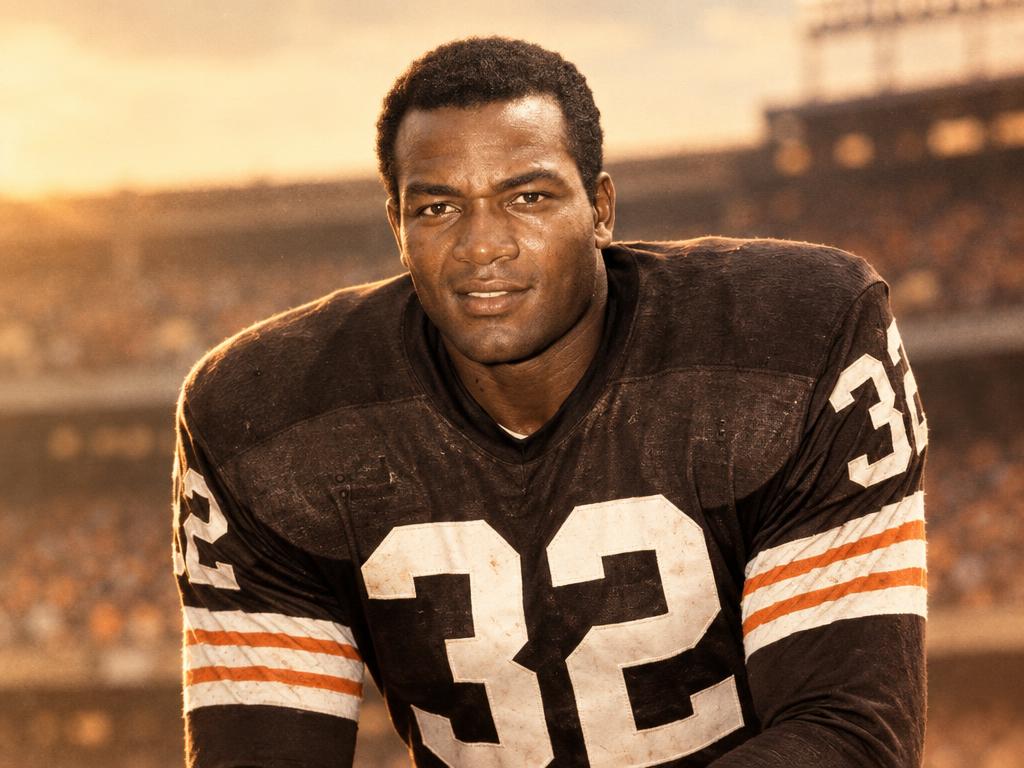
Jim Brown played fullback with the force of someone who expected the defense to move. The Cleveland Browns selected him sixth overall in the 1957 NFL Draft, and he immediately became one of the league’s most productive runners. Brown mixed acceleration with balance and strength, turning routine carries into long gains and making tackling him a demanding assignment. He played all nine of his professional seasons in Cleveland, from 1957 through 1965, and left the game while still at the height of his powers.
Brown led the NFL in rushing eight times and topped 1,000 yards in seven seasons, including years when the league schedule was shorter than today’s. He earned Rookie of the Year recognition, was named the league’s Most Valuable Player three times, and appeared in nine Pro Bowls. In 1963 he rushed for 1,863 yards, then an NFL single-season record. His 1964 season ended with Cleveland beating Baltimore 27–0 for the NFL championship, Brown’s only title. He retired after the 1965 season, at age 29, rather than extend a career that had already set a high standard.
Brown’s impact reached beyond football. At Syracuse University he was an All-American in football and lacrosse and also lettered in basketball and track. His athletic range was so broad that football statistics capture only part of his college reputation. After leaving the Browns, he pursued acting, appearing in films including The Dirty Dozen, and continued to speak about racial inequality. In 1967 he organized the Cleveland Summit, where prominent Black athletes publicly supported Muhammad Ali’s opposition to the Vietnam War draft.
Brown finished with 12,312 rushing yards, 106 rushing touchdowns and 15,459 combined net yards. The Pro Football Hall of Fame enshrined him in 1971; he was also elected to the College Football Hall of Fame and National Lacrosse Hall of Fame. His career remains striking for its concentration: nine seasons, almost uninterrupted production, and a retirement decision made before decline. Brown was a singular athlete and a consequential public figure, though his complicated life beyond sport should be understood alongside his achievements.