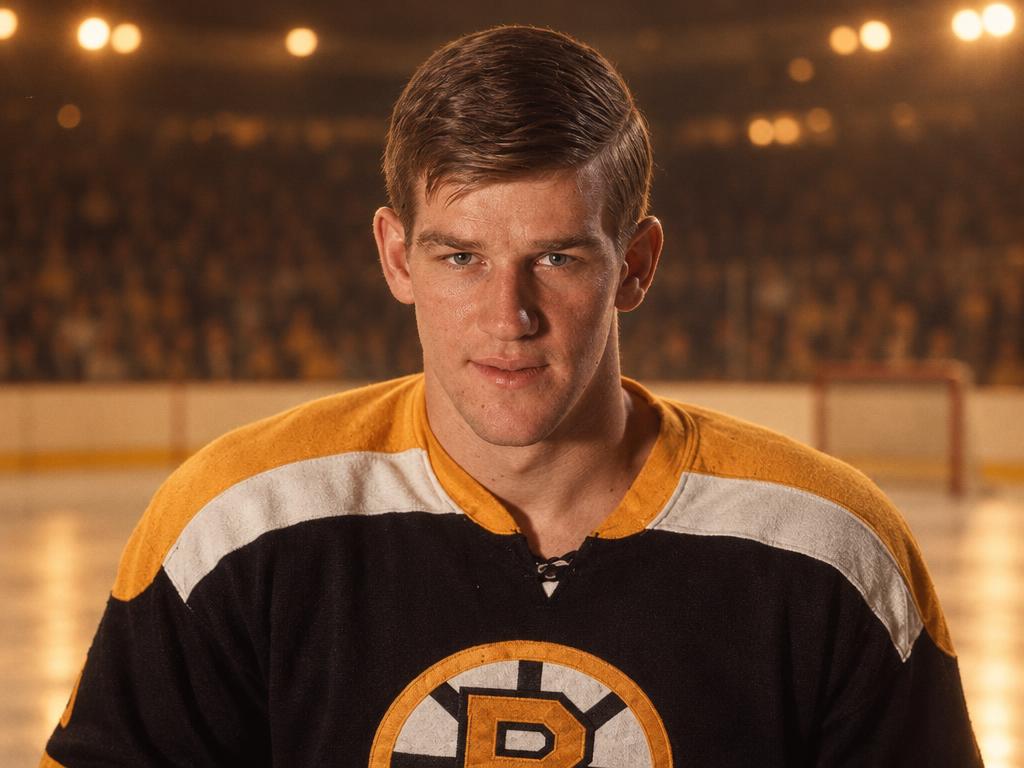
Bobby Orr was born in Parry Sound, Ontario, and grew up playing hockey on the frozen waters of Georgian Bay. Boston Bruins scout Wren Blair noticed him as a boy, and the club signed him before his 14th birthday. Orr joined the Bruins for the 1966–67 season at age 18. He was already an unusually fluid skater, able to turn defense into offense by carrying the puck himself rather than simply moving it to a forward. That style soon made him the most recognizable defenseman in the NHL.
Orr won the Calder Trophy as the league’s top rookie, then captured the Norris Trophy as its best defenseman in each of the next eight seasons. His peak included a rare sweep of major honors: in 1969–70 he won the Norris, Hart Trophy as MVP, Art Ross Trophy as the league’s leading scorer and Conn Smythe Trophy as playoff MVP. He remains the only defenseman to win the Art Ross. Orr’s 1970 championship-clinching overtime goal against St. Louis, followed by his airborne celebration, became one of hockey’s defining photographs. Boston also won the Stanley Cup in 1972, with Orr again earning the Conn Smythe.
Injuries shadowed his success. Repeated knee operations limited his mobility and shortened a career that began with a revolution on the ice. Orr played his final NHL game in 1978 after moving to the Chicago Black Hawks, but his impact reached beyond the seasons he could complete. He showed that a defenseman could lead the rush, create scoring chances and still anchor the back end. Coaches and young players increasingly treated skating and puck movement as core defensive skills, not optional flair.
Orr’s NHL totals—270 goals, 645 assists and 915 points in 657 games—stand out even before considering the era and position in which he produced them. He was inducted into the Hockey Hall of Fame in 1979, the year after retiring; the Hall waived its usual waiting period. He later became a representative for players, helping younger professionals navigate contracts and careers. The legacy rests on both achievement and a vivid change in how the game was played: for a generation of fans, a defenseman could look like the sport’s most exciting attacker.