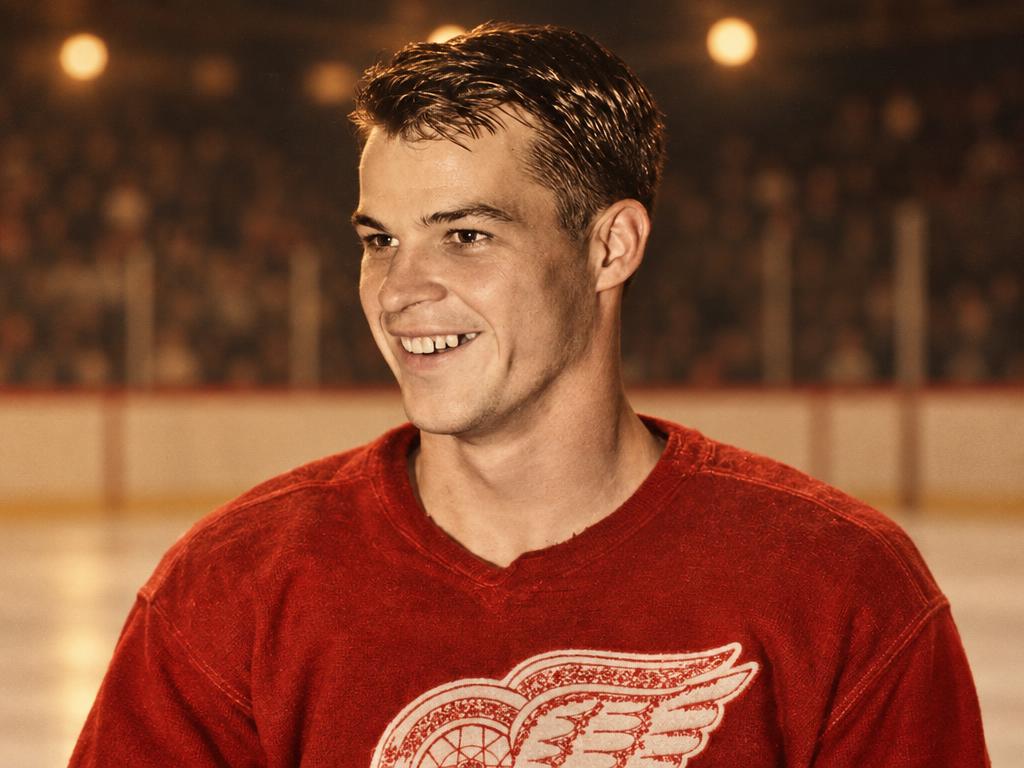
Gordie Howe grew up in Saskatchewan during the Depression, one of nine children in a family that could not take hockey for granted. His father made a stick from a piece of lumber, and young Gordie learned to skate on outdoor ice before joining organized teams. Detroit signed him as a teenager, and he made his NHL debut with the Red Wings in 1946. A right winger with a heavy shot and uncommon strength, Howe soon became central to a Detroit team that mixed speed with a hard edge.
Howe helped the Red Wings win four Stanley Cups, including three in a six-season span from 1952 through 1955. Alongside center Sid Abel and left wing Ted Lindsay, he formed the celebrated Production Line, a unit whose chemistry helped Detroit dominate the regular season. Howe won the Hart Trophy as league MVP six times and led the NHL in points six times. He was not just a scorer: his physical play made opponents account for him every shift. The later phrase “Gordie Howe hat trick” describes a goal, an assist and a fight in one game, although Howe himself recorded that combination only twice.
After retiring in 1971, Howe returned to professional hockey two years later to play with his sons Mark and Marty for the Houston Aeros of the World Hockey Association. He won two WHA championships and remained a major draw as the league challenged the NHL. When the WHA merged into the NHL, Howe suited up for the Hartford Whalers in 1979–80, becoming the first player to compete in five decades. His final NHL season came at age 52, a striking coda to a career that had begun before television carried most games into American homes.
Howe finished his NHL regular-season career with 801 goals, 1,049 assists and 1,850 points in 1,767 games. Wayne Gretzky eventually passed his goals total, but Howe’s record as the NHL’s career scoring leader had stood for decades, and his 801 goals remain the most by a right wing. He was inducted into the Hockey Hall of Fame in 1972, and Detroit retired his No. 9. “Mr. Hockey” became an enduring figure because his career joined championship achievement to the rare ability to stay effective as the sport changed around him.