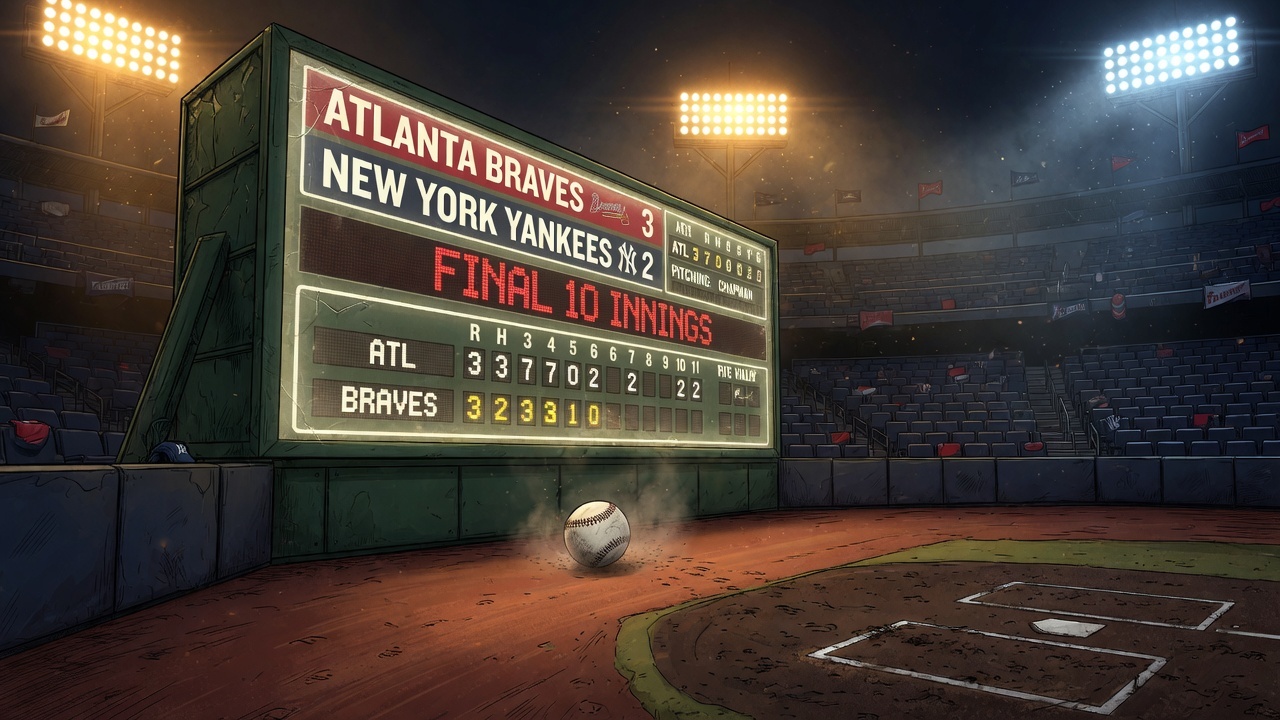
The Yankees did not beat Atlanta by outslugging it. They beat Atlanta by refusing to let a two-run hole become a dead end. After Max Fried and Tyler Mahle traded six-plus scoreless innings, the Braves were three outs from a clean road win. New York changed the game with a runner taking extra ground, a line-drive double, a tying single, and a sacrifice fly. That sequence—not the 3-2 final—is the real film-room lesson. )
Mahle finished six innings with three hits, two walks, and nine strikeouts. Fried went 6.1 innings, allowing three hits and two walks while striking out seven. Both starters kept the middle innings locked down. Atlanta finally broke through in the eighth when Austin Riley hit a solo homer off Fernando Cruz, then Matt Olson added another solo shot against Tim Hill in the ninth. Those were clean, isolated punches. New York’s answer had to be connected. )
- ⚾ In the bottom of the ninth, George Lombard Jr. singled and reached third when an Atlanta error extended the play. That extra ninety feet mattered. Austin Wells did not need to chase a home run; he needed a ball into space. He delivered a line-drive double to right, scoring Lombard and cutting the deficit to 2-1. One baserunner, one defensive mistake, and one precise swing created the inning. )
- 🔥 The next job was continuation, not power. Ben Rice punched a sharp single to right, Wells scored, and Amed Rosario moved to third. New York tied the game without a walk, stolen base, or three-run blast. Two straight balls in play kept the chain moving and forced Atlanta to defend multiple bases. The Braves’ solo homers created separation; the Yankees’ contact erased it. )
- 🧤 That is where the bullpen story changes. Raisel Iglesias recorded two outs but surrendered three hits and both ninth-inning runs. Tyler Kinley entered for the tenth with the game level, and New York again avoided the temptation to hunt for a dramatic swing. Luis García Jr. scored on Ryan McMahon’s sacrifice fly, giving the Yankees a 3-2 walk-off win. The winning run came from positioning and contact. )
- 📌 The line score shows why this was more than a lucky bounce. Both teams finished with seven hits, but Atlanta left six runners on base while New York stranded 13. The Yankees were not efficient all night. They were more resilient when the game narrowed to its final opportunities. Wells supplied the RBI double, Rice delivered the tying hit, and McMahon accepted the productive out. )
The bigger takeaway is a repeatable late-inning sequence: get a runner on, take the extra base when the defense gives it, hit the ball hard behind the situation, then trust the next hitter to move the game forward. Atlanta’s lead was built on two solo homers. New York’s final three runs were connected by baserunners and consecutive pressure. That is why the Yankees won a game they had mostly failed to control offensively. They did not need a thunderbolt. They needed three useful decisions in a row. )