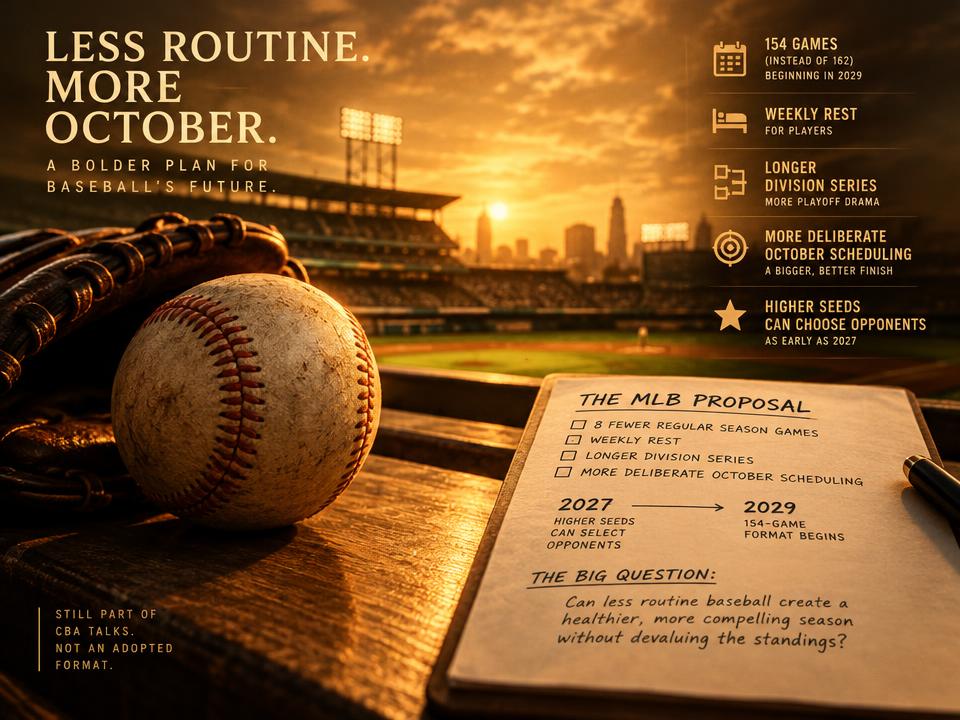
MLB’s proposed 154-game season is not really a haircut; it is a calendar redesign with a competitive price tag. The league wants eight fewer regular-season games, a weekly off day for most clubs, and a best-of-seven Division Series that can add as many as eight postseason games. The attractive pitch is obvious: fewer weekday afternoon playoff starts and more October games with an ace available. The harder question is whether the proposal improves baseball—or moves its most meaningful leverage from the standings into October.
Timing matters. The 154-game schedule and seven-game Division Series would begin in 2029, while opponent selection is proposed for 2027. Most Mondays would be off, with one or two national-TV exceptions; those teams would shift their off day to Thursday. MLB says the weekly pause can ease player wear and roster churn. But the plan also calls for four split day-night doubleheaders per team, one against each division rival. So this is not simply eight fewer games: it redistributes workload and broadcast inventory across the calendar.
Eight games are about five percent of a 162-game schedule. That sounds modest until the final week: with fewer games to separate contenders, a single hot or cold stretch carries more weight in deciding who earns a bye, a home series or a pick. That is an inference, not a guaranteed outcome, but the design clearly asks the schedule to do more work with less evidence. Fewer games also mean fewer chances to chase counting-stat milestones; per-game performance remains, while career totals lose opportunities.
The opponent-choice rule pushes that leverage into a public decision. The No. 3 seed would choose between the No. 5 and No. 6 clubs for the Wild Card Series; after that round, the No. 1 seed would choose its Division Series opponent from the two winners. Higher seeds gain something beyond home field: a chance to target a matchup they trust. Yet choice is not control. A club that avoids a feared rival may look cautious, and the overlooked opponent gets a ready-made slight to carry into the series. Managers would have to weigh scouting, health and psychology—not just the bracket.
Then comes the pitching trade. More off days and a seven-game Division Series give clubs room to line up their best starters and use them more often, precisely the stars MLB wants on the biggest stage. That can make October more compelling, but it can also make playoff baseball less like the regular season: a deep rotation and a handful of elite arms could matter more than the everyday depth that survived 154 games. The calendar may reduce routine strain while concentrating the highest-intensity work on teams that advance.
The proposal is still a bargaining proposal, not a new rule. MLB has tied the package to a cap-and-floor system, which the players’ association has criticized and says it will address at the table. That matters: fans can debate the schedule on its baseball merits, but none of these changes stands alone in the negotiation. The central trade is clear enough to argue about now: keep the familiar 162-game grind and five-game Division Series, or trade some regular-season volume for predictable weekly rest, a roomier October and a new layer of matchup strategy. That last layer could make seeding feel more consequential—or make the bracket feel like a reality show.